
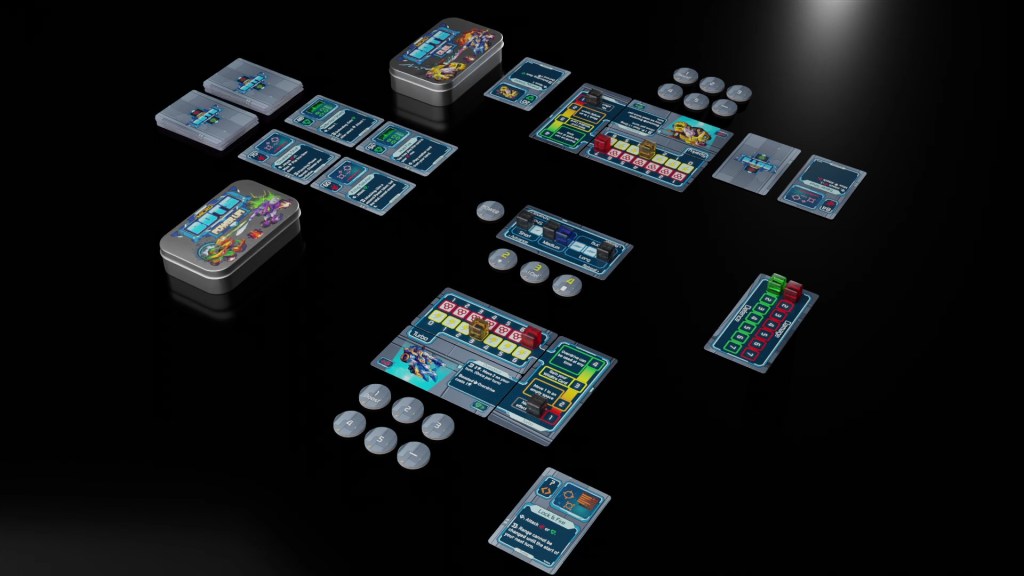
About a year ago, I signed my first publishing deal for my mint tin game, Laser Bots (which I previously discussed here). Ben Downton of Prometheus game Labs really liked the game, but wanted to develop it further to better fit his line of games. This is how we developed Laser Bots into Micro Bots.
Cooperation is Key
In late 2021 I revisited Laser Bots, intending to adapt it to a 1-4 player cooperative boss battler. I developed two ways of doing this: a full board game where you move bots around an arena, and a more abstracted card-based version that use the range trackers from Laser Bots in place of the arena board.

In need of a brainstorm session, I made a video call to Ben, hoping he could help me decide (I already knew Ben from various Facebook game designer groups). Ben hadn’t played Laser Bots before, so we had a quick game so he better understood the system. He really enjoyed the game and, with it being a pocket sized strategy game, asked if I would be interested in a publishing deal – obviously I said yes.
However, before committing to a deal, Ben wanted some changes made to the game. Primarily he wanted the dice to be replaced to make the game one of pure strategy (to fit in with his line of games). He also requested a change to how the cards increased in power, rather than the single row of action cards that became more powerful depending on the number of cards to the left or right.
Design Evolution
My first challenge was the dice – dice combat had always been a part of the game’s design, so changing such a core mechanism required a change of mindset. The dice were also tied to the range tracker (the range determined the target number to roll) and your row power (more cards meant you rolled more dice).
Once I removed the dice, a simple attack vs. defence value system seemed like a good way to go. And from there, using the row power (number of cards) as the base attack was a good fit. Following that train of thought, it then became obvious that the range would now determine the base defence.
This was a good start to the combat system, but fixed values like this do not make for exciting battles – some uncertainty was needed. My options were limited due to the game being mint tin sized, so tokens were the most viable choice. Having a range of numbers for each player (0 to 5) kept the uncertainty of combat whilst adding bluffing and more strategy to the game. Making each token one use would make for some crunchy decisions – do you use your 5 token to defend a big attack or save it for when you return fire? The game already had the Recharge card for regaining cards and energy, so it was easy to expand that to ready exhausted power tokens as well.
The final change I made was capping the damage from a single attack to 3. This prevents one-shot kills early in the game, and gives plenty of opportunities to turn the tide of battle in your favour. This also added a nice cadence to the game, a push and pull that I love in two player games.
Addressing the second of Ben’s requests, I had already explored some ideas in the coop implementation so I adapted one of those ideas. Each bot now has two rows: weapon and support. Most cards can only be played to one of your rows, adding an additional layer of strategy and play style.
These were significant changes to the game. In many ways it was still the same game, but it was also a very different, and better, game now. The strategy and interaction had ramped up to 11. And the feeling of playing the player rather than hoping for a lucky roll made the gameplay experience so much better.
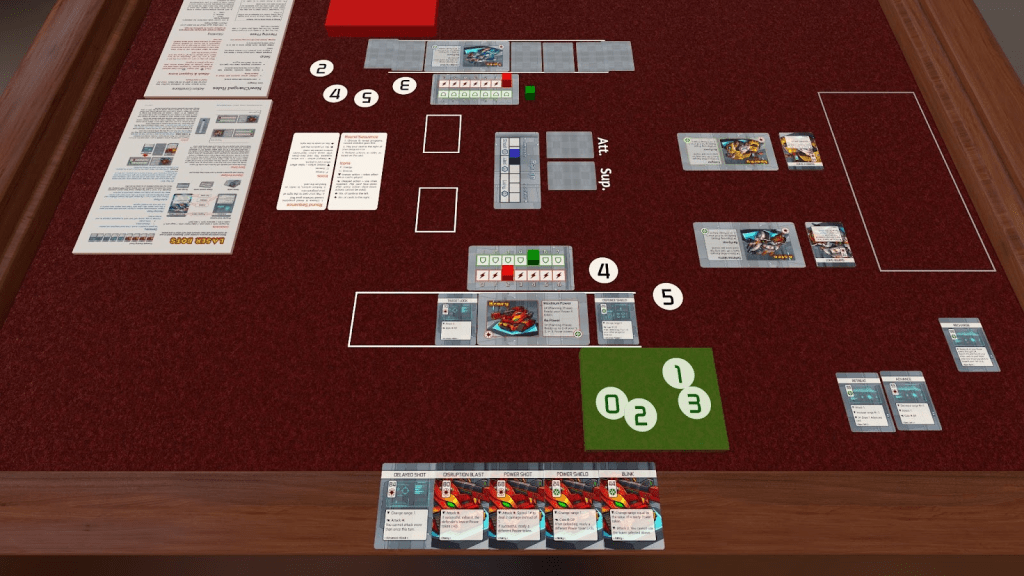
Obviously, Ben liked the changes. A deal was signed and we renamed the game Micro Bots as a follow on from his previously published game, Micro Dojo. We had regular video meetings to develop the game further. The change to the combat and row mechanisms meant a lot of bot and card abilities needed to be changed. However, the core changes also opened up the design space, so we had a lot of freedom when updating the card and bot abilities. What followed was many, many sessions of testing, discussing, balancing and tweaking. Many battles were fought, many bots exploded, and much fun was had.
Powering Up
From the outset, we had always intended to release an expansion with the core game. I had the additional bots and several ideas that simply would not fit in the base game tin. And harking back to its video game origins, I wanted to expand on the range track and have Pow Ups that players could pick up to improve their bots.

Early in the game’s development we had also talked about having special power tokens, so adding upgraded tokens and having them as the thing you pick up was an obvious choice to make. I also liked the idea of gradually powering up your bot, so I recycled some unused ideas and created the power up cards.
We tried a few variations of how players collect tokens and powered up, but ultimately we took the simple option of doing both every time you land on a power up cube. We wanted to avoid adding more passive abilities, which resulted in the creation of the Wildfire cards – a wild card that can be placed in either row, that also has a powerful attack and ability unique to each bot.

Final Thoughts
Creating Micro Bots has been quite a journey. From a computer game I created over 25 years ago, to a big box game, to a mint tin game, and finally to a fully developed, strategic duelling game – it has been quite the ride.
Developing the game with Ben has been a great experience. It certainly would not be the game it is without his involvement. Being pushed to make changes I would not have considered, and are just the sort of challenge I relish. And to have that culminate in the publication of my first game is just the icing on the cake.
And what of the boss battler that started this adventure with Prometheus Game Labs? Well, watch this space…
 Another Dimension
Leave a comment